sound waves
theory
experiment
invitation
afterthoughts
beatings
theory
experiment
invitation
afterthoughts
resonance
theory
experiment
invitation
afterthoughts
How does shape influence sound?
To understand this question, I will start by explaining what those words mean to me:
- Sound: Vibrating air at such speed that we experience this movement as sound. For this you need a sound source (producer), a medium that carries the sound (for example air or water) and someone or something that hears it, a listener or receiver (for example a human or microphone).
- Medium, body4 or space: The material or particles that carry the sound waves. That can be air, water, wood, metal, ceramics…(gas, liquid or solid)
- Shape or border: The dividing line between two mediums.
- Influence: When a sound is created it moves through the medium 1, the medium of his origin. At some point it encounters a border (shape) created by another material – medium 2. Depending on when it encounters the border and which kind of material the medium 2 is, certain tones will be bounced, absorbed or continue their journey through the second medium.

4. With body I’m referring to material body. Air body, wooden body, clay body… not specifically to human body.
For example:
Imagine you are inside a room and you hit a ceramic tone bar of a ceramophone.5 By hitting, you make the ceramic (medium 1) tone bar vibrate. The ceramic makes the air (medium 2) around vibrate creating sound waves. Through the air, the waves continue their journey. Some waves will directly enter your ears, others will bounce with the walls (medium 3) and then arrive at your ears and some waves will continue their journey through the walls.
Also, body and shape, together, influence the sounds we experience. For this research I will focus on shape, doing experiments with the same materials (clay, ceramic and air) with different shapes and comparing the results.
A more precise question could be: How do the borders of a medium where sound waves are produced influence the experience of the listener in terms of resonance, volume, quality, texture, reverb, echo…
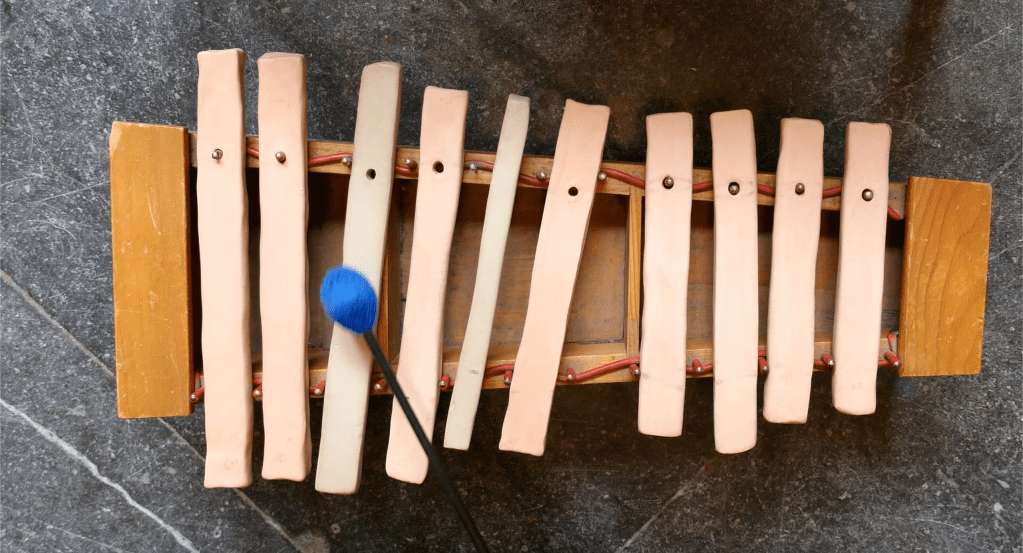
5. Ceramophone: ceramic xylophone
I make a distinction between inner space and outer space. Inner space (or instruments space) being the space inside the acoustic chamber of an instrument and the outer space being the space where the sound source and the listener are.

In the case of an inner space, the acoustic chamber of traditional instruments is made in a way that it resonates with the whole frequential range of the instrument. For example, in the case of a violin, the inner space is made to amplify all frequencies of the strings. Still there will be certain frequencies that resonate more.6
In the case of an outer space, people (architects, sound engineers…) search for the right acoustics depending on the function of a space, searching sometimes for more reverb (reflections) and sometimes for less reverb. Depending on the function of the space they give it a certain shape and use certain materials. (architectural acoustics)
Searching for the difference between both spaces I found out that the physics of how sound behaves in both spaces is finally the same. The difference between inner space and outer space becomes then: what is the goal of the space and where do you place the ear of the listener.
Besides the shape of the space where the sound waves are, the sound source and the listener can move. When that happens the sound experience of the receiver will also change. To understand possible influences and changes of sound experience I want to start with to the simplest sound: a sine-wave.
6. Hermann Helmholtz “On the sensations of tone”, 87 Musical tones of bowed instruments
You will find 4 chapters:
- sound waves
- beatings
- resonance
- shaping
Each chapter includes:
- a little theoretical explanation
- one or more experiments I made
- an invitation/composition that you can experience yourself
- afterthoughts
All these different phenomena are connected with each other and will give me and you a better understanding about how shape influences sound. This sounds very theoretical while I’m an artist that normally starts first by making and later thinking.
I make something
I listen to it
I share it
I reflect on it
and I make a new version
To fully understand something, I like to combine the theory with physical experiments. Some chapters will be theoretical, others more experimental and some more conceptual. I will support the words with drawings, animations, photos and videos.
I decided to follow my curiosity. Trusting that my desire to understand and to do experiments will shape my research.
Questions I had and have:
- How do sound waves move in space? Do they move? sound waves : theory : sound waves
- When a sine wave is played in a space: Why are some points louder than others? sound waves : theory : traveling waves and standing waves
- Does this happen with all frequencies? also higher frequencies? sound waves : experiment : sine wave as a standing wave in space
- How do standing waves happen in space? sound waves : theory : traveling waves and standing waves
- Can a sine wave be a moving wave? or is it always a standing wave? sound waves : theory : traveling waves and standing waves
- Can you have beatings with two tones that are changing from a lower frequency to a higher frequency? beatings : invitation : beatings from to 2 tones : both tones changing
- What is the relation between combination tones and beatings? I finally did not research combination tones.
- Is the amplitude of a standing wave higher when it is the resonant tone of the space where it is produced? resonance : theory
- How do sound waves move inside a sphere? shape : experiment : How do sound waves move inside a sphere? – Still a question that intrigues me.
- How can a tone resonate in a sphere that is not as big as the wavelength of the tone itself? shape : theory : sphere – Still a question that intrigues me.
- Why isn’t it possible to overblow an ocarina (sphere shape) to hear overtones, and it is possible to overblow a conventional flute (tube shape)? shape : experiment : sphere, cube vs tube-flute – Still a question that intrigues me.
 Gemma Luz Bosch