sound waves
theory
experiment
invitation
afterthoughts
beatings
theory
experiment
invitation
afterthoughts
resonance
theory
experiment
invitation
afterthoughts
waves
There are two different types of mechanical waves:
- Transverse waves: for example; when two persons hold a rope, each person one end of the rope, and one of them moves the string up and down in a constant pulse. A wave is sent along the rope. Transverse waves involve oscillations perpendicular to the direction in which the wave travels.

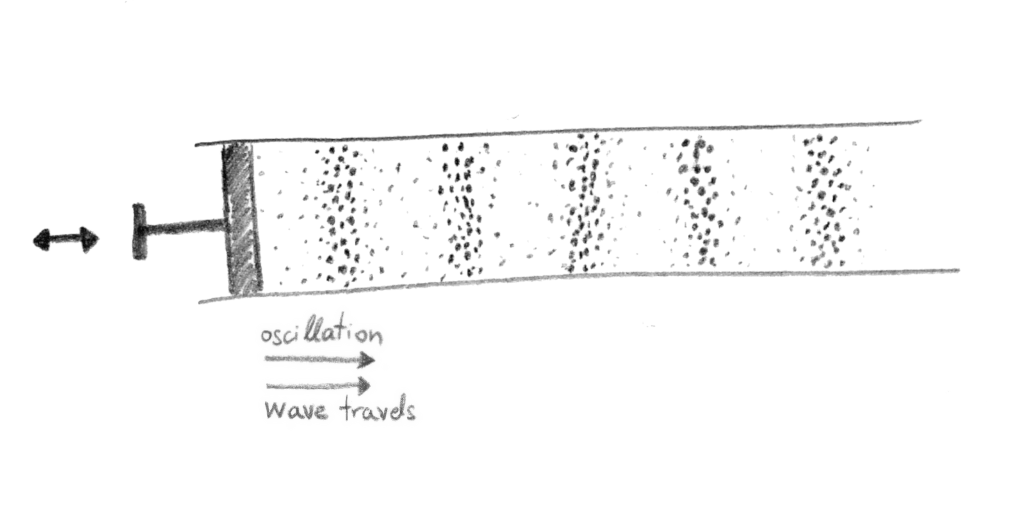
- Longitudinal waves: for example; when you push and pull a piston in a tube in a constant oscillation, a wave travels through the tube. Longitudinal waves involve oscillations parallel to the direction of wave travel.7
7. David Halliday, Jearl Walker and Robert Resnick “Fundamentals of physics”, 445, 446 & 479 Waves I and Waves II.
sound waves
In physics, sound waves are oscillations that travel through a medium.
In psychology sound waves are the oscillations we can hear. We can perceive frequencies between 20Hz and 20.000Hz. (Hertz = oscillation per second). This is the average spectrum of frequencies that we can hear, but of course each ear and person is different. More about experiencing sound in sound waves : afterthoughts : feeling sound
Sound waves that propagate through gas or liquid are always longitudinal. Sound waves that propagate through solid can be longitudinal or transversal. Often longitudinal sound waves are represented as transverse waves for practical reasons: easier to represent them and understand them. From now on I will represent all sound waves as transverse waves. In the video above you can see how the longitudinal representation relates to the transversal representation.
We have several elements in a sound wave:
- The amplitude is the intensity of a sound wave. A soft sound will have less amplitude than a loud sound. The amplitude is the magnitude of the maximum displacement of the air particles in relation to their equilibrium position as the wave passes through them.
- The wavelength of a wave is the distance (parallel to the direction of the wave’s travel) between repetitions of the oscillations of the wave. The wavelength (λ) is equal to the velocity of the sound wave (v) divided by its frequency (f) λ = v/f *
- The frequency of a sound wave is the pitch. A low tone has a low frequency and a high tone has a high frequency. The frequency is often measured in Hertz, which are oscillations x second.
- The velocity of sound is the speed of propagation of the wave through a space. The velocity of sound (v) is equal to the space (s) it has traveled divided by the time (t) it has taken. v = s/t
- The quality or timbre are the characteristics of a sound that allow us to distinguish tones with the same pitch and loudness. Mainly thanks to the difference in attack (starting moment of a sound), vibrato and overtones.
- The phase specifies the location or timing of a point within the oscillation.8

Diferent phase, same frequency, same amplitude:

8. David Halliday, Jearl Walker and Robert Resnick “Fundamentals of physics”, 477 Waves I.
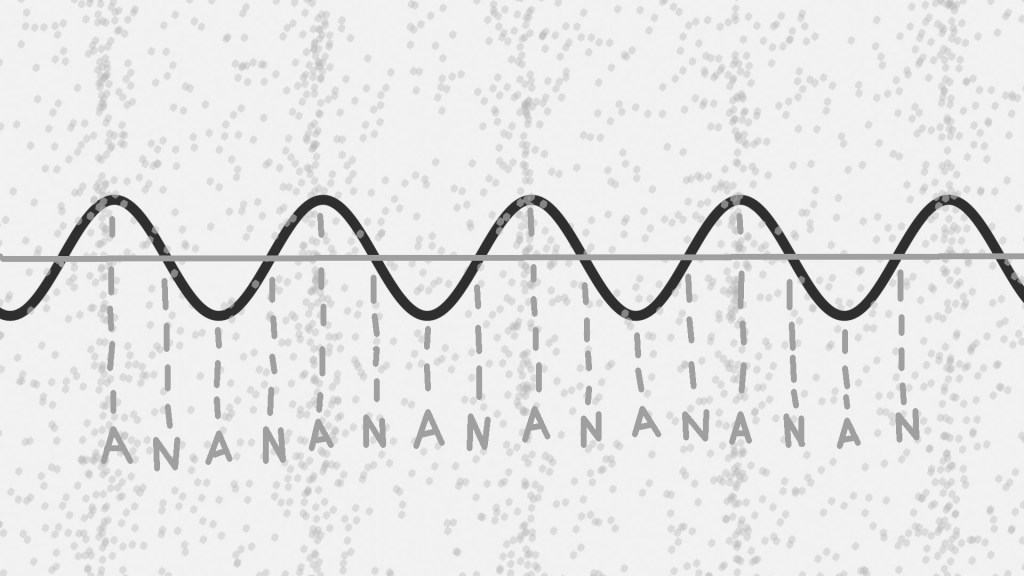
Sound waves have nodes (N) and antinodes (A). The antinodes are the points with maximum air pressure difference (fluctuating between high pressure and low pressure) and the nodes the points with minimum change in air pressure.

sine waves
A sine wave is the most simple and pure sound wave possible; it is one frequency without overtones. To create a pure sine wave, the sound source produces a completely constant pulse, a constant oscillation.
I’m curious if pure sine waves can exist in a physical space. You can produce a sine wave with a speaker, but you always will have reflections from the shape of the room that will make the sine wave ‘imperfect’. Maybe in an un-echo chamber, a space without reflections, you could experience a pure sine wave in space.
traveling waves and standing waves
- Traveling waves are sound waves in which their nodes and antinodes move in space
- Standing waves oscillate in time but their nodes and antinodes don’t move in space.9
Standing waves occur, for example, when you play a sine wave inside a space. The sine wave travels from the sound source (the speaker), through the medium (air), bounces on the borders of the medium (walls) and travels back through the medium (air), having two waves with exactly the same wavelength: the original sine wave and its reflection. Their sum is a constructive interference10 pattern, creating a louder wave which is a standing wave.
Here a video of standing waves from 2 traveling waves:11
Can a sine wave be a traveling wave? Or is it always a standing wave?
A sine wave can be a traveling wave or a standing wave depending on the conditions, shape and medium in which it propagates. In general, all sound waves are traveling waves, but when a sine wave is produced inside a space it bounces off the borders creating standing waves.
If you produce a sine wave outside, into the infinity of vibrating air12 the wave will propagate as a moving wave.
9. Glenn Elert “The physics Hypertextbook”, Standing Waves.
10. Interference is further explained in the chapter beatings : theory : interference.
11. All animations made by Know Art Studios.
12. David Toop “Spectres II, Resonances”, 49 Resonant Frequency.
 Gemma Luz Bosch