sound waves
theory
experiment
invitation
afterthoughts
beatings
theory
experiment
invitation
afterthoughts
resonance
theory
experiment
invitation
afterthoughts
resonance
Bodies tend to oscillate in certain frequencies (these are their natural frequencies) A sound wave has a certain wavelength and a body has a certain dimension. The sound waves reflect on the borders of the medium creating standing waves with the frequencies that ‘fit’, determined by the geometry and acoustic properties of the body. These sound waves create a constructive interference pattern making them louder, because of their higher amplitude.
The lowest natural frequency is the fundamental frequency. All natural frequencies above the fundamental are overtones. The fundamental frequency is usually the loudest tone of a tone, overtones are often present but softer and are difficult to consciously hear. Harmonics are a type of overtones, harmonics are the whole integer multiples20 of the fundamental frequency. All harmonics are overtones but not all overtones are harmonics.
Resonance happens when the frequency of an external force of vibration matches one (or more) of the natural frequencies of a body.21 When resonance happens the sound interference is constructive therefore the wave will sound louder than other pitches.
When you play a ceramic sound bar on one side or the other side you hear different tones:
20. Integer multiple: the numbers you get when you multiply a certain number
21. Glenn Elert “The physics Hypertextbook”, Standing Waves Summary
Here an example of how to know the fundamental frequency and the harmonics of a room. Knowing the velocity of sound and the room dimensions you can calculate them. Imagine a room(body) of 2 meters by 2 meters by 2 meters.
We know how to calculate the wavelength (λ) of a sound wave: λ = v/f.
λ = wavelength = d = Room dimension in meter (length, width and height)
v = Velocity of sound (343 meter per second)
f = frequency
The fitting (resonating) frequencies will be the sound waves with wavelengths that fit the dimensions of the room. They have the same length or integer multiples of the length of the room.
To know the frequencies, we have to clear the formula:
step one: f * λ = v
step two: f = v/λ
Being the wavelength of the sound wave the dimension of the room in meters:
f = v/d
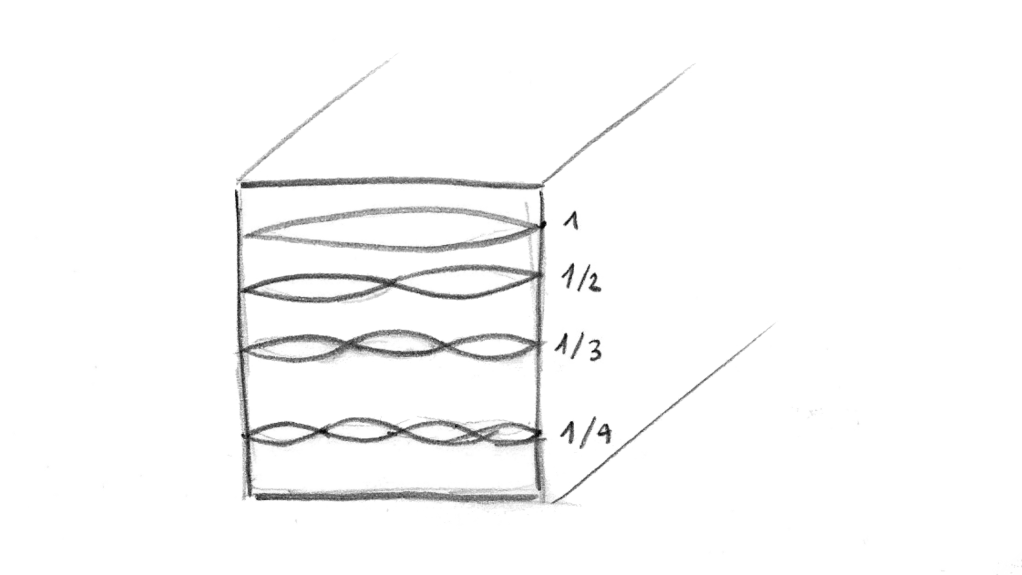

As you can see in the drawing the wavelength of the fundamental frequency is double as big as the room dimensions. Then the formula to calculate the fundamental frequency of a room becomes:
f = v / 2d
f = 343 / (2×2) = 85,75 Hz
This means that the lowest natural frequency of the room will be 85,75Hz.
Here below I calculate the integer multiples of the natural frequency:
first harmonic x2
f = v / 1d
f = 343 / (1×2) = 171,5 Hz
second harmonic x3
f = v / (2/3)d
f = 343 / (0,5×2) = 257,25 Hz
third harmonic x4
f = v / (1/2)d
f = 343 / (0,5×2) = 343 Hz22
All this is calculated with the idea that the sound source is placed on one of the sides of the room, and only propagating in the direction of the opposite side of the room.
The fundamental frequency and the corresponding harmonics will create a constructive interference pattern, sounding louder than other frequencies.
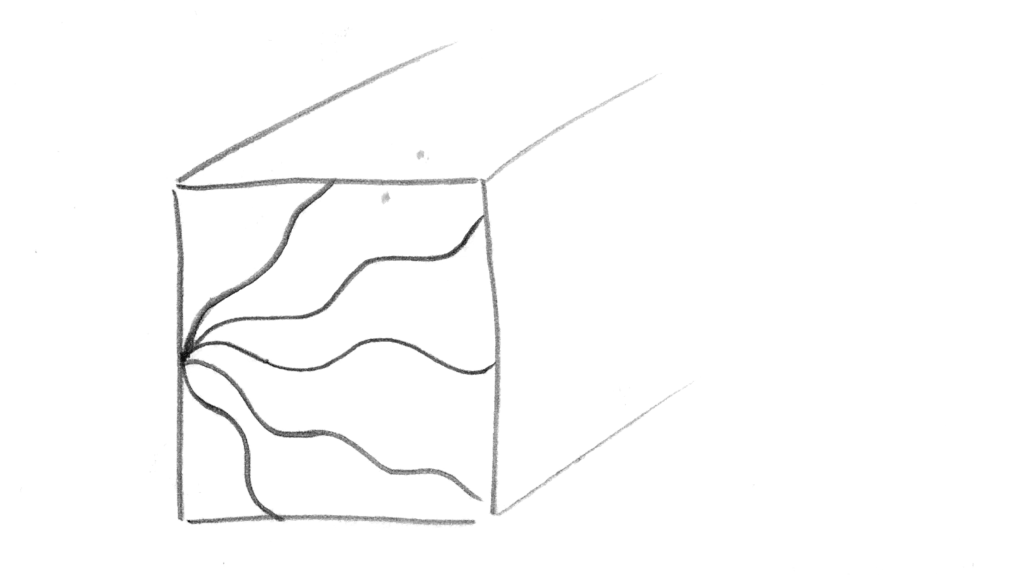
We don’t have to forget that sound moves in all directions, therefore a room does not have only one natural frequency and harmonics.
22. mh-audio, calculators, “Helmholtz Resonator”.
Helmholtz resonators
Helmholtz resonators are metal spheres with on one side a neck with a hole, and on the other side a hole. Resonators aren’t instruments, they don’t produce sound, they invite you to listen. The sounds from outside enter through the hole, then the frequency that resonates in the resonator resonates (becomes louder than other tones) and you can listen, placing your ear in the hole of the neck.

The spherical shape makes one tone resonate (constructive interference creating a standing wave), this tone sounds louder inside than outside the resonator. The tones that don’t resonate are cancelled out (deconstructive interference), they sound softer (or even completely silence) inside the resonator than outside. The resonator functions as an acoustic sound filter23: amplifying the resonant frequencies and attenuating other frequencies.24
23. Filter: We are all familiar with how a filter works, for example a paper filter to keep the coffee grounds out of your coffee. In the case of a sound filter, it’s not filtering depending on the size of the particles, but depending on the wavelength.
24. J.F. Chandler ”Basic Acoustics and Acoustic Filters”, 14 & 15.
sympathetic resonance
Sympathetic resonance happens when an oscillating body matches the natural oscillating frequency of another body. The energy of the first body will start moving the second body.
For this phenomenon you need bodies with certain elasticity, bodies which when once set in motion by an impulse they continue to vibrate for some time before they stop moving. Bodies that resonate easily are for example: strings, membranes, springs, certain wood…25
25. Hermann Helmholtz “On the sensations of tone”, 36 Mechanics of sympathetic resonance.
 Gemma Luz Bosch